The original article was written in Persian; the following is a translation of the original article.
1. Introduction
Cultural poverty is an inherently complex issue that cannot be easily identified. Multiple criteria have been proposed to define it, varying across different societies. In the context of Iranian society, cultural poverty is interpreted as a deviation from religious values and national identity. Economic and cultural poverty are deeply interconnected and have historically influenced one another reciprocally.
In impoverished communities—those suffering from numerous constraints and deficiencies—the primary struggle has often been to meet the basic need for housing. Economic deprivation significantly impacts the architecture of these communities. In such contexts, architecture lacks in aesthetic, functional, and cultural dimensions. Buildings are reduced to mere shelters against environmental elements such as wind, sunlight, and rain, failing to meet other human needs. Here, both architecture and its users succumb to economic hardship, which in turn perpetuates societal regression. Cultural poverty thus emerges as a coexistent factor alongside economic poverty.
Rapid and unbalanced physical urban development has led to adverse economic, social, and physical consequences. One of the most prominent outcomes of such disproportional urban growth is the emergence of informal settlements and urban marginalization .
The phenomenon of slum and informal housing expanded after the Industrial Revolution, initially in developed countries and subsequently in developing nations, and continues to persist. The imposition of economic growth and development programs by industrialized countries gave rise to slum formation in developing regions as well [4].
Architectural services—an amalgam of science and art—have become luxury commodities in the modern era, thereby excluding a significant portion of the population. This exclusion fosters the emergence of informal settlements, which are closely tied to financial poverty and are prevalent across most major cities. These residences often consist of a single undivided space that houses an entire family and lack essential components such as courtyards, sanitary facilities, and storage. Such living conditions starkly reflect socio-economic inequality and the unjust distribution of wealth. Poverty itself carries a distinct, intricate, and often misunderstood cultural character.
The dissemination of modern construction technologies and equipment generally aligns with the framework of social justice. Another dimension of architecture—art and aesthetics—persists even within impoverished communities, though often viewed with condescension. Consequently, it becomes necessary to properly identify, refine, and represent these aesthetic expressions, akin to traditional music and local attire, but within the architectural domain—form, space, and beyond.
In vernacular and poverty-induced architecture, the user’s creativity plays a primary role, while technological input is minimal. Conversely, in the architectural practices of middle- and upper-class societies, the aesthetic choices of master builders and other specialists become more pronounced. Architecture reflects the full spectrum of a society’s culture and resources.
Several factors influence poverty-induced architecture, which can broadly be categorized into two groups:
- Variables intrinsic to architecture itself, such as climate and culture;
- Variables dependent on the societal approach to poverty, which are highly influenced by governmental programs.
Research conducted over the past half-century has largely been descriptive and case-based, merely outlining the problem. Therefore, there is an urgent need for ongoing applied research that, while grounded in reality, is capable of generating internally-driven solutions to improve prevailing conditions.
2. Literature Review
The relatively comprehensive study of informal settlements in Iran began in the late 1960s. The earliest organized investigations commenced in 1963 with the establishment of the Ministry of Housing and Urban Development, under the supervision of its Department of Social Affairs. These studies primarily provided descriptive accounts of life in marginal neighborhoods [5].
In the early 1970s, with the collaboration of the Plan and Budget Organization and the Institute for Social Studies and Research at the University of Tehran, informal settlements in several major Iranian cities—including Bandar Abbas, Hamedan, and Kermanshah—were studied. These investigations characterized the general features of these settlements and classified them based on housing types [6].
During the 1980s, a significant body of work was developed by Parviz Piran. Published gradually throughout the 1980s and 1990s in the Political and Economic Information monthly journal, his research substantially enriched the theoretical discourse on urban poverty and informal housing in Iran. Piran addressed exogenous development, urbanization, and slum formation from both theoretical and empirical perspectives. He proposed a three-tiered model—micro, meso, and macro levels—for understanding the causes of informal settlement formation, which he further applied in subsequent case studies [7].
In the 1990s, a field-based research project on marginalization in Iran—specifically in Tehran—was undertaken. This relatively detailed study explored the historical background, causes, and characteristics of the phenomenon. The findings were later published under the title Marginalization in Iran and Solutions, which critically examined the role of formal institutions and urban planning in contributing to the emergence of informal settlements [8].
Meanwhile, in the 1970s, many developing countries recognized their inability to address the housing crisis for low-income populations using existing top-down approaches focused on construction and shelter provision. Consequently, the role of the state shifted from direct provider of housing to enabler of services, fostering the empowerment of residents. This transformation allowed marginalized groups to engage in various aspects of housing development, including construction, financial planning, and project management [9].
In another study aimed at addressing the problem of informal settlements, researchers utilized the Analytic Hierarchy Process (AHP) to prioritize possible solutions, arriving at the following conclusions [10]:
- First priority: Relocating residents of informal settlements to neighborhoods with improved living conditions.
- Second priority: Redevelopment of the neighborhood in accordance with legal and urban standards.
- Third priority: Upgrading current conditions and providing essential infrastructure.
In response to health and environmental issues caused by informal settlements, the Indonesian government proposed relocating affected residents. The proposed strategies were:
- Provision of sanitary infrastructure;
- Relocation to supported housing units;
- Relocation to supported apartment units.
Using AHP and evaluating strategies based on criteria such as cost, available technology, environmental impact, and accessibility, researchers reached the following conclusions [11]:
- Best solution by cost: Provision of sanitary infrastructure;
- Best solution by available technology: Relocation to supported housing units;
- Best solution by environmental impact: Relocation to supported apartment units;
- Best solution by accessibility: Provision of sanitary infrastructure;
- Best overall solution across all criteria: Relocation to supported apartment units.
4. Research Methodology
The Analytic Hierarchy Process (AHP), developed by Thomas L. Saaty in the 1970s [12], is one of the most well-established multi-criteria decision-making techniques. The core of this method lies in pairwise comparisons of indicators and is especially useful when decision-making involves multiple options and both quantitative and qualitative criteria.
4.1: Steps of the Analytic Hierarchy Process
4.1.1: Step One — Defining the Main Objective
The first step involves establishing the primary goal of the study. In this research, the objective is to prioritize the indicators influencing the architecture of poverty.
4.1.2: Step Two — Structuring the Problem Hierarchically
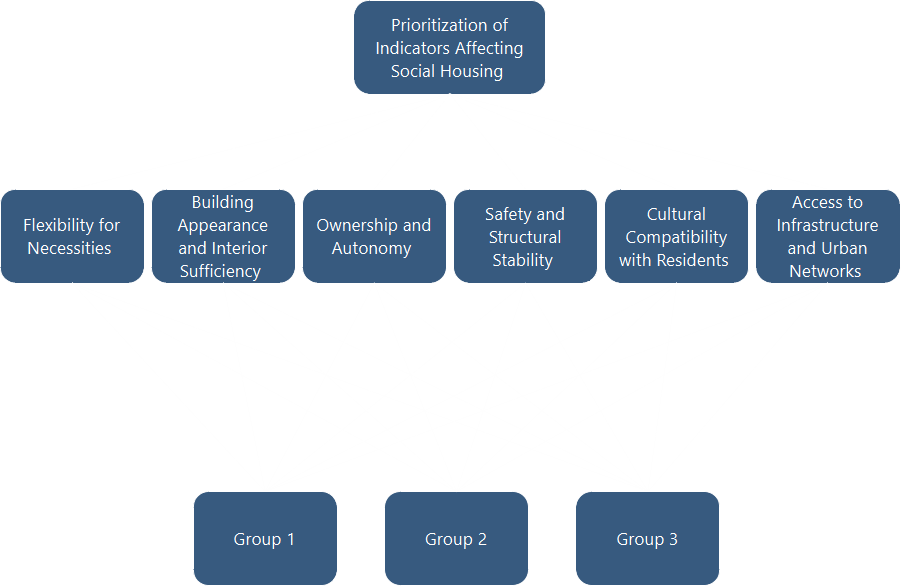
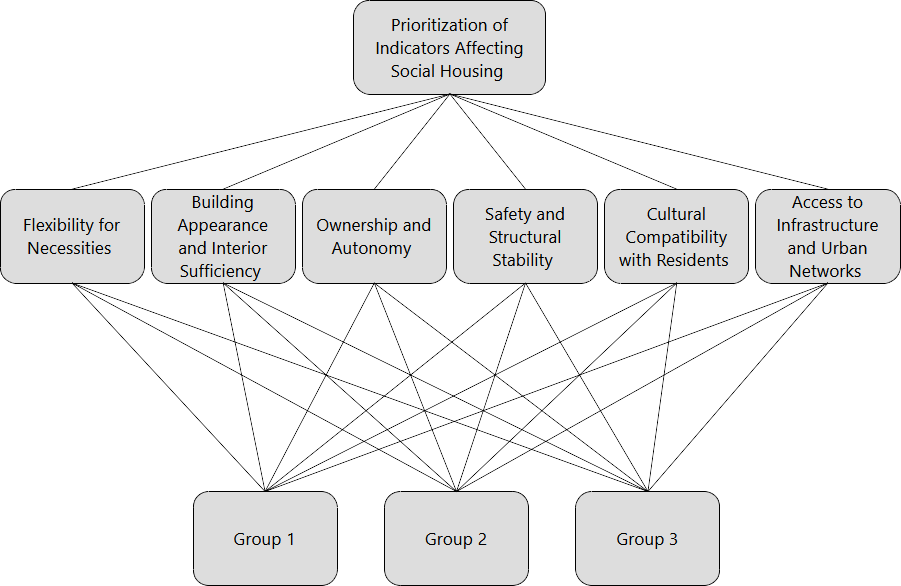
At this stage, the decision-making problem must be broken down into several indicators across hierarchical levels. Understanding the factors influencing housing for the poor is crucial for planning, designing, and constructing suitable settlements aimed at mitigating informal housing. Failure to adequately recognize or assign appropriate weight to these indicators may result in project failure.
To identify, examine, and classify the effective indicators, the author reviewed relevant literature and consulted experts in the field. Based on this process, the following indicators and their default sensitivity weights (assumed equally important at this stage) were identified and are listed in Table 1.
Table 1: Key Indicators Affecting Supportive Housing
| Ownership and Autonomy |
1 |
| Safety and Structural Stability |
1 |
| Building Appearance and Interior Sufficiency |
1 |
| Cultural Compatibility with Residents |
1 |
| Flexibility for Necessities |
1 |
| Access to Infrastructure and Urban Networks |
1 |
4.1.3: Step Three — Defining Comparative Options
In this step, the alternatives (or comparison groups) must be determined. Similar to other statistical populations, the residents of informal settlements cannot be categorized uniformly in terms of income, abilities, and needs. To allow more accurate analysis and evaluation of indicators, the target population has been divided into three groups based on socioeconomic conditions:
Group 1: The Severely Deprived
Individuals or families with no financial resources, earning capability, or labor potential. This group includes elderly or disabled individuals with neither workforce capacity nor reliable income.
Group 2: The Moderately Deprived
Individuals with minimal income or unskilled labor capacity. They are able to subsist at a basic level, with relatively less deprivation compared to Group 1.
Group 3: The Marginally Deprived
Individuals who possess labor potential and earn an income sufficient for survival, but not adequate for acquiring housing.
4.1.4: Step Four — Pairwise Comparison of Indicators
The next step involves expert-based comparisons and decision-making regarding the indicators. These comparisons are carried out using a scale of nine levels, as shown in Table 2. The preference of an indicator over itself is rated as one.
Table 2: Pairwise Comparison Scale of Indicators
| 1 |
Equal importance |
Two indicators are of equal significance. |
| 3 |
Slightly more important |
Indicator i is slightly more important than j. |
| 5 |
More important |
Indicator i is more important than j. |
| 7 |
Significantly more important |
Indicator i is much more important than j. |
| 9 |
Absolutely more important |
Indicator i is absolutely more important. |
| 2,4,6,8 |
Intermediate values |
Used when compromise is necessary between two judgments. |
Expert comparisons are conducted through a structured questionnaire, as exemplified in Table 3, where indicators to be compared are listed on either side. The expert selects the degree of preference indicating the relative importance of one indicator over the other.
Table 3: An example of the questionnaire, in this example Ownership & Autonomy is being compared to the rest of the indicators.
| Ownership & Autonomy |
O |
O |
O |
O |
O |
O |
O |
O |
O |
O |
O |
O |
O |
O |
O |
O |
O |
Safety & Stability |
| Ownership & Autonomy |
O |
O |
O |
O |
O |
O |
O |
O |
O |
O |
O |
O |
O |
O |
O |
O |
O |
Appearance & Sufficiency |
| Ownership & Autonomy |
O |
O |
O |
O |
O |
O |
O |
O |
O |
O |
O |
O |
O |
O |
O |
O |
O |
Cultural Compatibility |
| Ownership & Autonomy |
O |
O |
O |
O |
O |
O |
O |
O |
O |
O |
O |
O |
O |
O |
O |
O |
O |
Flexibility |
| Ownership & Autonomy |
O |
O |
O |
O |
O |
O |
O |
O |
O |
O |
O |
O |
O |
O |
O |
O |
O |
Infrastructure Access |
4.1.5: Step Five — Data Collection and Analysis
The researcher conducted a survey among experts using a questionnaire designed according to the AHP methodology. After collecting raw data, the results were processed using specialized AHP software to evaluate and rank the indicators based on predefined criteria.
5. Data Analysis
5.1: Group 1 Analysis — The Severely Deprived
This group includes individuals or households without any financial capacity, labor ability, or income—such as elderly or disabled individuals with no viable means of livelihood.
Table 4: Pairwise Comparison Matrix – Group 1
| Ownership & Autonomy |
1.00 |
0.25 |
5.00 |
3.00 |
0.50 |
0.20 |
| Safety & Stability |
4.00 |
1.00 |
6.00 |
4.00 |
3.00 |
0.50 |
| Appearance & Sufficiency |
0.20 |
0.17 |
1.00 |
0.25 |
0.25 |
0.17 |
| Cultural Compatibility |
0.33 |
0.25 |
4.00 |
1.00 |
1.00 |
0.20 |
| Flexibility |
2.00 |
0.33 |
4.00 |
3.00 |
1.00 |
0.20 |
| Infrastructure Access |
5.00 |
1.00 |
6.00 |
5.00 |
5.00 |
1.00 |
5.2: Group 2 Analysis — The Moderately Deprived
This group consists of individuals with low-skilled labor capacity or minimum income sufficient for basic subsistence.
Table 5: Pairwise Comparison Matrix – Group 2 {.striped} ### 5.3: Group 3 Analysis — The Marginally Deprived
| Ownership & Autonomy |
1.00 |
0.25 |
5.00 |
3.00 |
0.50 |
0.20 |
| Safety & Stability |
4.00 |
1.00 |
5.00 |
4.00 |
4.00 |
0.50 |
| Appearance & Sufficiency |
0.20 |
0.20 |
1.00 |
0.25 |
0.25 |
0.17 |
| Cultural Compatibility |
0.33 |
0.25 |
4.00 |
1.00 |
0.50 |
0.17 |
| Flexibility |
2.00 |
0.25 |
4.00 |
2.00 |
1.00 |
0.25 |
| Infrastructure Access |
5.00 |
2.00 |
6.00 |
6.00 |
4.00 |
1.00 |
This group includes individuals who have labor capacity and basic income but insufficient resources for securing adequate housing.
Table 6: Pairwise Comparison Matrix – Group 3
| Ownership & Autonomy |
1.00 |
0.25 |
4.00 |
3.00 |
4.00 |
0.25 |
| Safety & Stability |
4.00 |
1.00 |
4.00 |
4.00 |
4.00 |
0.50 |
| Appearance & Sufficiency |
0.25 |
0.25 |
1.00 |
0.33 |
0.33 |
0.17 |
| Cultural Compatibility |
0.33 |
0.25 |
3.00 |
1.00 |
0.50 |
0.20 |
| Flexibility |
0.25 |
0.25 |
3.00 |
2.00 |
1.00 |
0.20 |
| Infrastructure Access |
4.00 |
2.00 |
6.00 |
5.00 |
5.00 |
1.00 |
These matrices will be used to calculate weights and rankings of the indicators for each group using AHP computation tools.
6. Conclusion
The results of this study illustrate the prioritization and relative importance of each architectural indicator, based on the specific needs and socio-economic conditions of three distinct population groups. These indicators serve as criteria for constructing dwellings aimed at alleviating informal settlement challenges.
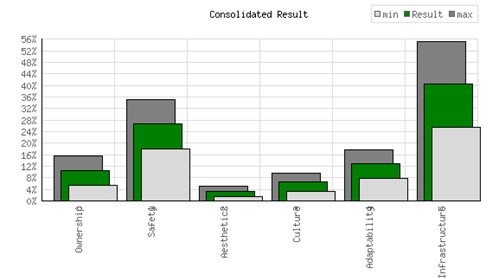
Table 7: Indicator Prioritization – Group 1 (Severely Deprived)
| Access to Infrastructure and Urban Networks |
1 |
40.4% |
| Safety and Structural Stability |
2 |
26.6% |
| Flexibility for Necessities |
3 |
4.9% |
| Ownership and Autonomy |
4 |
10.4% |
| Cultural Compatibility with Residents |
5 |
6.5% |
| Building Appearance and Interior Sufficiency |
6 |
3.3% |
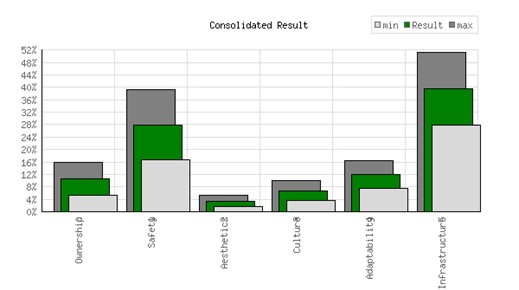
Table 8: Indicator Prioritization – Group 2 (Moderately Deprived)
| Access to Infrastructure and Urban Networks |
1 |
39.5% |
| Safety and Structural Stability |
2 |
27.9% |
| Flexibility for Necessities |
3 |
11.9% |
| Ownership and Autonomy |
4 |
10.6% |
| Cultural Compatibility with Residents |
5 |
6.7% |
| Building Appearance and Interior Sufficiency |
6 |
3.4% |
Table 9: Indicator Prioritization – Group 3 (Marginally Deprived)
| Access to Infrastructure and Urban Networks |
1 |
38.6% |
| Safety and Structural Stability |
2 |
27.9% |
| Ownership and Autonomy |
3 |
15.2% |
| Flexibility for Necessities |
4 |
7.9% |
| Cultural Compatibility with Residents |
5 |
6.5% |
| Building Appearance and Interior Sufficiency |
6 |
4.0% |
Interpretation
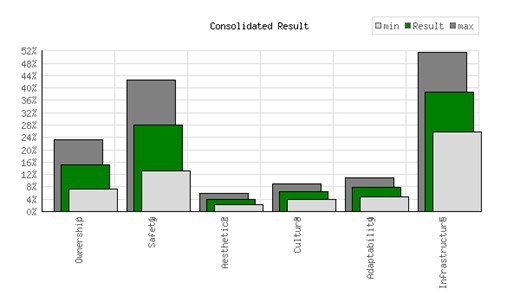
The findings highlight the varying significance of each indicator among different socio-economic groups. Notably, access to infrastructure and urban networks consistently ranks as the top priority across all groups. This emphasizes its foundational role in any housing initiative aimed at marginalized populations.
However, it is crucial to recognize that while relative rankings help prioritize interventions, every indicator remains fundamentally important. A ranking system should not imply that lower-ranked elements—such as building appearance—are dispensable. Rather, their design and implementation should be aligned with the project’s priorities, necessities, and principles of architectural adequacy.
From the perspective of the experts surveyed in this study, certain indicators warrant greater attention in practice, particularly when designing architectural interventions to serve vulnerable populations. Addressing these key areas increases the likelihood of successful implementation of housing and urban design projects targeted at reducing poverty and informal settlements.
Back to topReferences
[1]
R. Salehi Amiri and Z. Khodaei, Marginality and informal settlements: Challenges and consequences. Ghoghnus Publications, 2016.
[2]
Iranian Sociological Association and National Social Council, Social harms of marginalization: Neighborhood relations and apartment living. Agah Publications, 2013.
[3]
R. Mostafavi and N. Hashemzehi, Social harms in tehran: A meta-analysis of research on divorce and marginalization. Society; Culture Publications, 2011.
[4]
H. Farhadikhah, H. Hataminajad, and A. Shahi, “Residential patterns of migrants and their relation with urban poverty and marginality: Case of mashhad,” Urban Economics, vol. 4, no. 1, 2019.
[5]
A. Haj Yousefi, “Marginalization and its evolutionary process (pre-revolution),” Haft Shahr Quarterly, vol. 3, no. 8, pp. 12–24, 2002.
[6]
M. Ahsan, M. Niroumand, and R. Hoseini Karzani, Marginalization in hamedan and kermanshah. Institute for Social Studies; Research, University of Tehran, 1972.
[7]
P. Piran, “Squatter settlements in iran: Theoretical approaches with attention to iranian context,” Political-Economic Information, 1994.
[8]
M. of Housing and U. Development, “Marginality and its effects on cities: Recognizing the low-income as citizens,” Urban Development; Architecture Research Center of Iran, 1995.
[9]
R. J. Skinner, J. L. Taylor, and E. A. Wegelin, Shelter upgrading for the urban poor: Evaluation of third world experience. Island Publishing House, Inc., 1987.
[10]
D. Hema, “Analytical hierarchy process (AHP) methods for slum development analysis,” International Journal of Mathematics and Computer Applications Research, vol. 2, no. 2, pp. 14–32, 2012.
[11]
M. S. Dewi, D. M. Hartono, S. S. Moersidik, and I. Kustiwan, “Analytical hierarchy process for decision making in managing slum area,” International Journal of Engineering Research & Technology, vol. 6, no. 4, 2017.
[12]
H. Ghodsipour, Analytic hierarchy process (AHP). Amirkabir University Press, 2000.
Citation
For attribution, please cite this work as:
F.
Panahirad and M. Ansarimanesh,
“Identifying and Surveying
Parameters Affecting the Architecture of Poverty and Prioritizing Them
Using the Analytic Hierarchy Process,” in
10th International
Congress on Civil Engineering, Architecture & Urban Development,
Tehran, Iran., Dec. 2024. Available:
https://f.panahirad.website/blog/posts/MS-Poverty/